

Resource-saving technology for environmental protection
The Institute of Agriculture of the Carpathian Region of the National Academy of Agrarian Sciences of Ukraine and DSK-Technologies s.r.o., recognizing the importance of developing a circular bioeconomy, rational resource use and scientifically grounded innovation in agriculture and the municipal sector, concluded a Memorandum on long-term cooperation and scientific and practical consulting. The Parties agreed to develop comprehensive cooperation in scientific research, exchange of experience and innovation for agricultural and municipal enterprises and the sustainable development of rural and urban areas. The main objective is the scientific substantiation and practical implementation of innovative resource-saving technologies for the complete integrated processing of agro-industrial waste, particularly animal biomass, as well as sewage sludge, to create safe liquid organomineral fertilizers, including fertilizers with chelated nutrient forms. The main areas of long-term cooperation are:
• Study of the composition, properties, quality and safety of raw materials and their processed products;
• Laboratory and field testing of the developed fertilizers;
• Assessment of fertilizer effects on soil, crop growth, yield and quality;
• Development of recommendations for safe and effective fertilizer use.
P.S. UA Party-1 provides scientific and methodological support for the agreed research, laboratory and field testing, analysis of results and preparation of recommendations, while CZ Party-2 provides information on technological solutions, necessary materials and samples, ensures the production of experimental product batches and participates in pilot projects.
The Czech company DSK-Technologies s.r.o. implements innovative technological processes for more complete processing of waste generated in Ukraine’s agro-industrial sector, particularly animal and plant biomass, to produce liquid organomineral fertilizers in chelated form. The company also establishes comprehensive long-term cooperation with municipal wastewater treatment enterprises to process sewage sludge for the production of liquid organomineral fertilizers in chelated form.
P.S. Long-term cooperation between Ukrainian agro-industrial enterprises, municipal wastewater treatment enterprises and the Czech enterprise is based on a long-term agreement establishing a simple partnership between the parties, which does not conflict with the Civil Code of Ukraine (CCU) or the Civil Code of Czechia (CCC).
Keratin-containing fertilizer
Technical specifications (TУ У 20.1-41602953-002:2026)
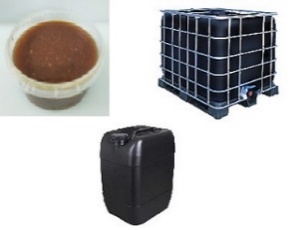
Organic fertilizer with protein compounds, amino acids and humic substances.
Concentrated keratin-containing liquid mixture — a new-generation organic fertilizer.
For supplemental plant nutrition and support of yield formation.
Agricultural instalment payments for agribusiness!
A Ukrainian manufacturer of organic, environmentally clean fertilizers in chelated form, combining natural components and modern biotechnology; essentially, this liquid mixture is an organomineral fertilizer with a high content of protein compounds, amino acids and humic substances.
The main component is keratin hydrolysate — a breakdown product of the natural protein keratin, obtained by biohydrolysis of keratin-containing raw materials. The process preserves all bioactive compounds that provide plant nutrition at the cellular level. The preparation contains natural organic nitrogen, sulfur, amino acids, peptides and micronutrients in chelated form, which are readily absorbed even in adverse weather conditions.
Physicochemical characteristics of the concentrated keratin-containing liquid fertilizer mixture
Form: liquid.
Colour: light brown to dark brown.
Packaging: 20 L canisters, 1000 L IBC containers.
Shelf life: 12 months in the manufacturer’s unopened container at +5…+25 °C.
Composition: keratin hydrolysate, humic acids, macro- and micronutrients (Fe, Mn, Zn, Cu) in chelated form, organic acids, amino acids, sulfur.
Main advantages of the fertilizer
•Biologically active formula — ensures rapid nutrient uptake by plants without nitrate accumulation.
•Growth biostimulant — activates root system and leaf mass development and improves photosynthesis.
•Increases plant resistance to drought, frost, fungal and bacterial diseases.
•Improves soil structure — stimulates beneficial microflora development and promotes humification.
•Higher yields — productivity increases of up to 15–35 % and improved quality.
•Environmental safety — monitoring of toxic element content and sanitary-hygienic parameters is provided for in accordance with the technical specifications.
•Combination with other preparations — use together with chelates, biostimulants and microbiological preparations is permitted.
Keratin-containing fertilizer is versatile and suitable for:
•Field crops (wheat, maize, rapeseed, soybean, barley);
•Vegetable crops (beet, carrot, cabbage, tomato, potato);
•Orchards, vineyards and berry plantations;
•Protected cultivation and ornamental plants.
Keratin-containing fertilizer is produced by processing keratin-rich raw materials.
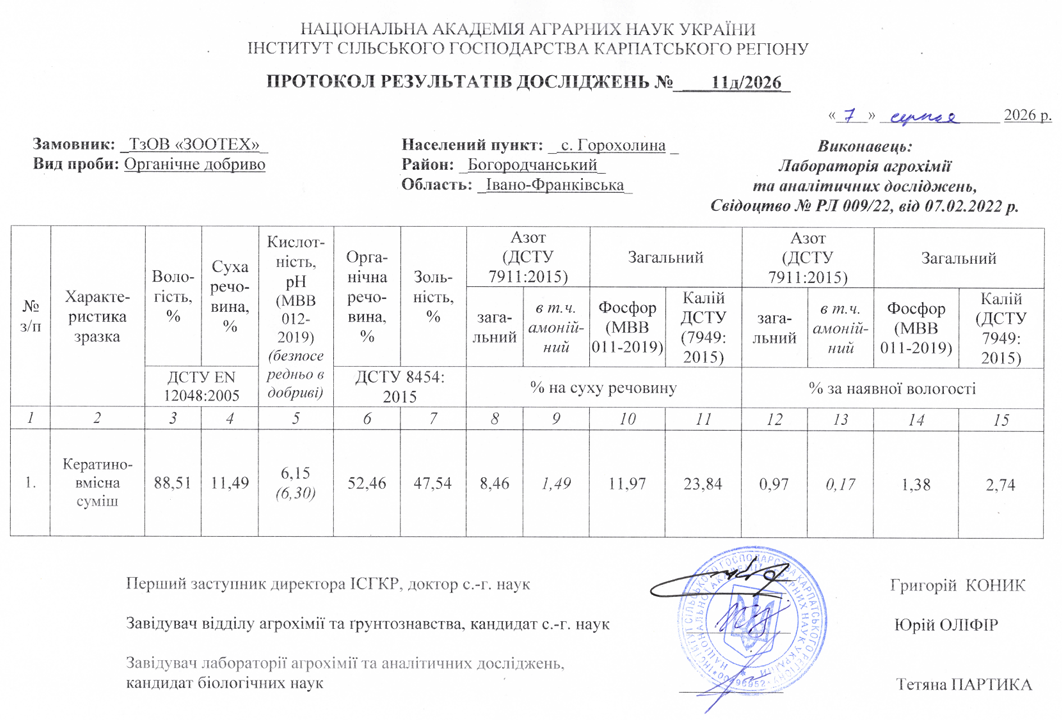
During processing, the complex protein structure is partially broken down and the raw material components enter a liquid form suitable for crop production. This product combines amino acids and other organic nitrogen-containing substances with phosphorus, potassium and other mineral components. The dry matter mass fraction in the tested samples is 11,5–11,8 %. More than half of the dry residue consists of organic matter (52,5–67,6 %), while ash components account for 32,5–47,5 %. Thus, the fertilizer has a pronounced organic base and also contains a substantial mineral fraction.
The pH of the tested samples ranges from 6,15–6,48, corresponding to a slightly acidic, near-neutral reaction. When preparing working solutions for foliar feeding of crops, not only the fertilizer pH but also solution concentration, water quality and crop sensitivity are considered.
The primary use is foliar feeding. It may be considered for cereals, grain legumes, oilseeds, forage, vegetable, fruit and berry crops. Application may be particularly appropriate during intensive leaf growth, formation of generative organs, grain or fruit filling, and after drought, cold spells, temperature fluctuations or other stress factors.
For each batch of liquid or loose solid fertilizer made to order, the pH is adjusted to the required level when necessary. The adjustment method and substances used are selected according to the fertilizer composition.
These substances may simultaneously provide additional nutrients. This dual action therefore allows fertilizer composition to be selected for different stages of plant development — vegetation, flowering and fruiting.
Fertilizer composition is selected according to crop needs at different development stages — growth, flowering and fruiting. Suitability at each stage and the application rate are clarified through testing.
To develop fertilizers for specific soils and crops, agrochemical and physicochemical analyses of mineral and peat soils are considered: moisture, particle size distribution, acidity, nitrogen, phosphorus, potassium, calcium, magnesium, aluminium, sulfur and other parameters as needed. The main quality parameters of organic fertilizers are also determined: moisture, ash, pH, nitrogen, phosphorus and potassium. The results are used to select organomineral fertilizer formulations according to the agricultural enterprise’s needs.
P.S. Chelated organomineral fertilizers are effective solutions for agricultural production, combining natural components, modern biotechnology and environmentally clean production approaches. They ensure stable growth and high yields, prevent nutrient leaching, help restore soil structure and develop soil microflora, which is important for maintaining soil fertility and sustainable agricultural development.
Founder of fertilizer production in Ukraine
Kononenko Serhii Viktorovych
+38 093 052 4775
Company management head office
+420 720 604 121
Recommendations
for the integrated
application of keratin-containing fertilizer
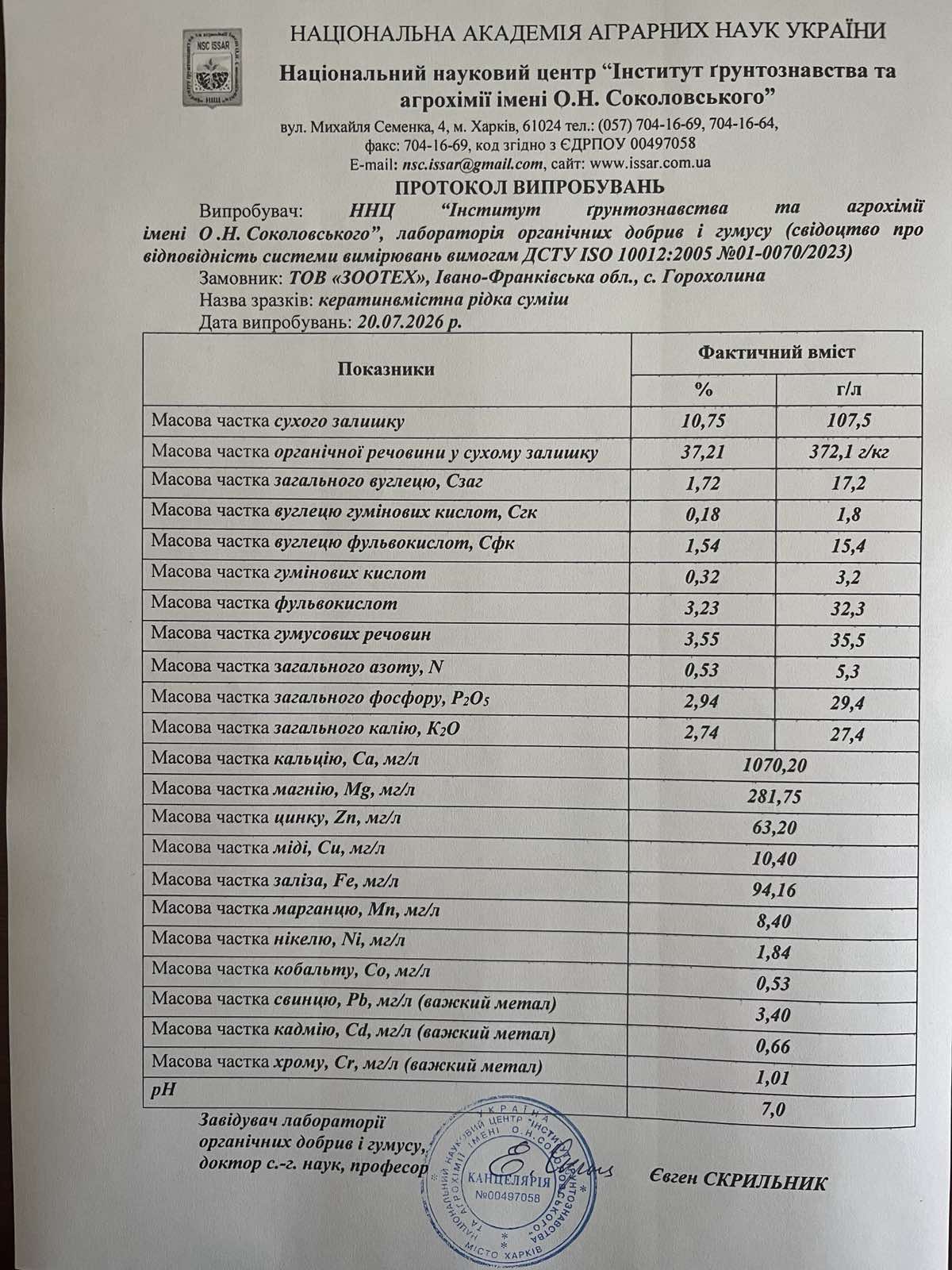
Keratin-containing fertilizer is a concentrated liquid mixture based on processed keratin-containing protein raw materials. It contains organic components, nitrogen, phosphorus, potassium, humic and fulvic acids, calcium, magnesium and micronutrients. The main application method is spraying plants with an aqueous solution for supplemental feeding during the growing season.
According to the technical specifications, total nitrogen at actual product moisture is 0,53–0,97 %, phosphorus expressed as P2O5 is 1,38–2,94 %, and potassium expressed as K2O is 2,31–2,74 %. Dry matter content is 10,0–12,0 %, with organic matter accounting for 37,0–68,0 % of it. The reaction is slightly acidic to neutral — pH 6,15–7,00.
The protein component may support nitrogen metabolism and plant growth processes. Amino acids and peptides formed during processing may enter metabolic processes and influence nutrient use by plants. This may support leaf development and recovery of growth after adverse conditions.
Mineral components complement this action: nitrogen is needed for protein formation and growth, phosphorus participates in energy metabolism, and potassium regulates water balance and enzyme activity. Together, these components may support plant nutrition and physiological condition during active growth and yield formation. The strength of the effect depends on fertilizer composition, application rate, plant condition and treatment conditions.
For wheat, barley and other cereals, indicative application stages are tillering and stem elongation. At these stages, the fertilizer may provide supplemental nutrition during active growth and leaf development.
Later treatments, including during grain filling, are possible depending on crop needs and test results.
For maize and sunflower, indicative treatment stages are active leaf formation. For soybean, pea and other grain legumes, it is the period before budding. For vegetable, fruit and berry crops, application is possible during active growth and yield formation. For forage and ornamental crops, treatments are planned according to their development patterns.
Application may support plants after drought, cold spells or temperature fluctuations. Treat after conditions improve and plants resume normal activity. Postpone spraying during heat or pronounced water stress.
Before preparing the working solution, mix the fertilizer thoroughly until homogeneous. Use clean water, add concentrate while stirring and bring to the required volume. Filter if necessary according to sprayer and nozzle requirements. Do not apply undiluted concentrate directly to leaves, young shoots, buds or open flowers.
Spray in the morning or evening at moderate temperatures, without strong wind or intense sunshine. Avoid treatments before expected rain or when the solution dries rapidly. Wet leaves evenly without runoff.
Before mixing with other fertilizers or plant protection products, check their instructions, perform a compatibility test and trial treatment on a small area. Calcium, magnesium and strongly alkaline preparations require particular attention. Do not use mixtures with flakes, sediment, excessive foam or persistent separation.
Consultations on agrochemistry and fertilizer application
Tetiana Volodymyrivna Partyka
Mon–Fri, 1400–1700
+38 067 336 9265