

Resource-saving technology for environmental protection
The Institute of Agriculture of the Carpathian Region of the National Academy of Agrarian Sciences of Ukraine and DSK-Technologies s.r.o., recognizing the importance of developing a circular bioeconomy, rational resource use and scientifically grounded innovation in agriculture and the municipal sector, concluded a Memorandum on long-term cooperation and scientific and practical consulting. The Parties agreed to develop comprehensive cooperation in scientific research, exchange of experience and innovation for agricultural and municipal enterprises and the sustainable development of rural and urban areas. The main objective is the scientific substantiation and practical implementation of innovative resource-saving technologies for the complete integrated processing of agro-industrial waste, particularly animal biomass, as well as sewage sludge, to create safe liquid organomineral fertilizers, including fertilizers with chelated nutrient forms. The main areas of long-term cooperation are:
• Study of the composition, properties, quality and safety of raw materials and their processed products;
• Laboratory and field testing of the developed fertilizers;
• Assessment of fertilizer effects on soil, crop growth, yield and quality;
• Development of recommendations for safe and effective fertilizer use.
P.S. UA Party-1 provides scientific and methodological support for the agreed research, laboratory and field testing, analysis of results and preparation of recommendations, while CZ Party-2 provides information on technological solutions, necessary materials and samples, ensures the production of experimental product batches and participates in pilot projects.
The Czech company DSK-Technologies s.r.o. implements innovative technological processes for more complete processing of waste generated in Ukraine’s agro-industrial sector, particularly animal and plant biomass, to produce liquid organomineral fertilizers in chelated form. The company also establishes comprehensive long-term cooperation with municipal wastewater treatment enterprises to process sewage sludge for the production of liquid organomineral fertilizers in chelated form.
P.S. Long-term cooperation between Ukrainian agro-industrial enterprises, municipal wastewater treatment enterprises and the Czech enterprise is based on a long-term agreement establishing a simple partnership between the parties, which does not conflict with the Civil Code of Ukraine (CCU) or the Civil Code of Czechia (CCC).
Organic poultry-manure-based fertilizer
Technical specifications (TУ У 20.1-41602953-003:2026)
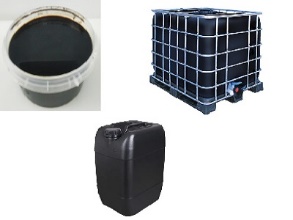
Humic-containing liquid mixture – an organic chelated fertilizer with humic and fulvic acids.
Increases yield, strengthens plant immunity and improves soil structure.
Agricultural instalment payments for agribusiness!
The humic-containing liquid mixture (chelated organic fertilizer) is a modern innovative product from a Ukrainian manufacturer, developed for effective crop nutrition and restoration of soil fertility.
What is the humic-containing liquid mixture?
This is a new-generation organic liquid fertilizer containing natural humic and fulvic acids, organic carbon and micronutrients (Fe, Zn, Cu, Mn, Mg, Ca) in chelated form. As a result, nutrients are absorbed by plants at 100 %, are not immobilized in the soil and act over a long period. Humic compounds restore soil microflora, activate biological processes, improve soil structure and increase plant resistance to stress – drought, frost and fungal diseases. The fertilizer can be used for fertigation, foliar feeding, and seed and seedling treatment.
Characteristics of the humic-containing liquid mixture
Form: liquid.
Packaging: 20 L canister, 1000 L IBC container.
Colour: dark brown.
Composition: humic acids, fulvic acids, micronutrients in chelated form, organic carbon.
Shelf life: 12 months in a closed container at +5 to +25 °C.
Main advantages of the chelated humic fertilizer:
• Activates root system development;
• Improves nutrient uptake (nitrogen, phosphorus, potassium, micronutrients);
• Increases yield and agricultural product quality;
• Stimulates growth and photosynthesis;
• Increases plant resistance to pests, diseases and adverse weather;
• Helps restore soil structure;
• Safe for people and the environment – 100% organic composition.
Where the humic-containing fertilizer is used:
• In cereal, vegetable, industrial and forage crops;
• In orchards, berry plantations and vineyards;
• In greenhouse production;
• During pre-sowing treatment of seeds and seedlings;
• For foliar feeding during periods of active growth.
The composite liquid mixture based on poultry manure is a complex organic fertilizer containing the main plant nutrients, organic matter, humic and fulvic acids, calcium, magnesium and a range of micronutrients. Its use returns organically derived nutrients to agricultural circulation and can partly reduce the need for mineral fertilizers.
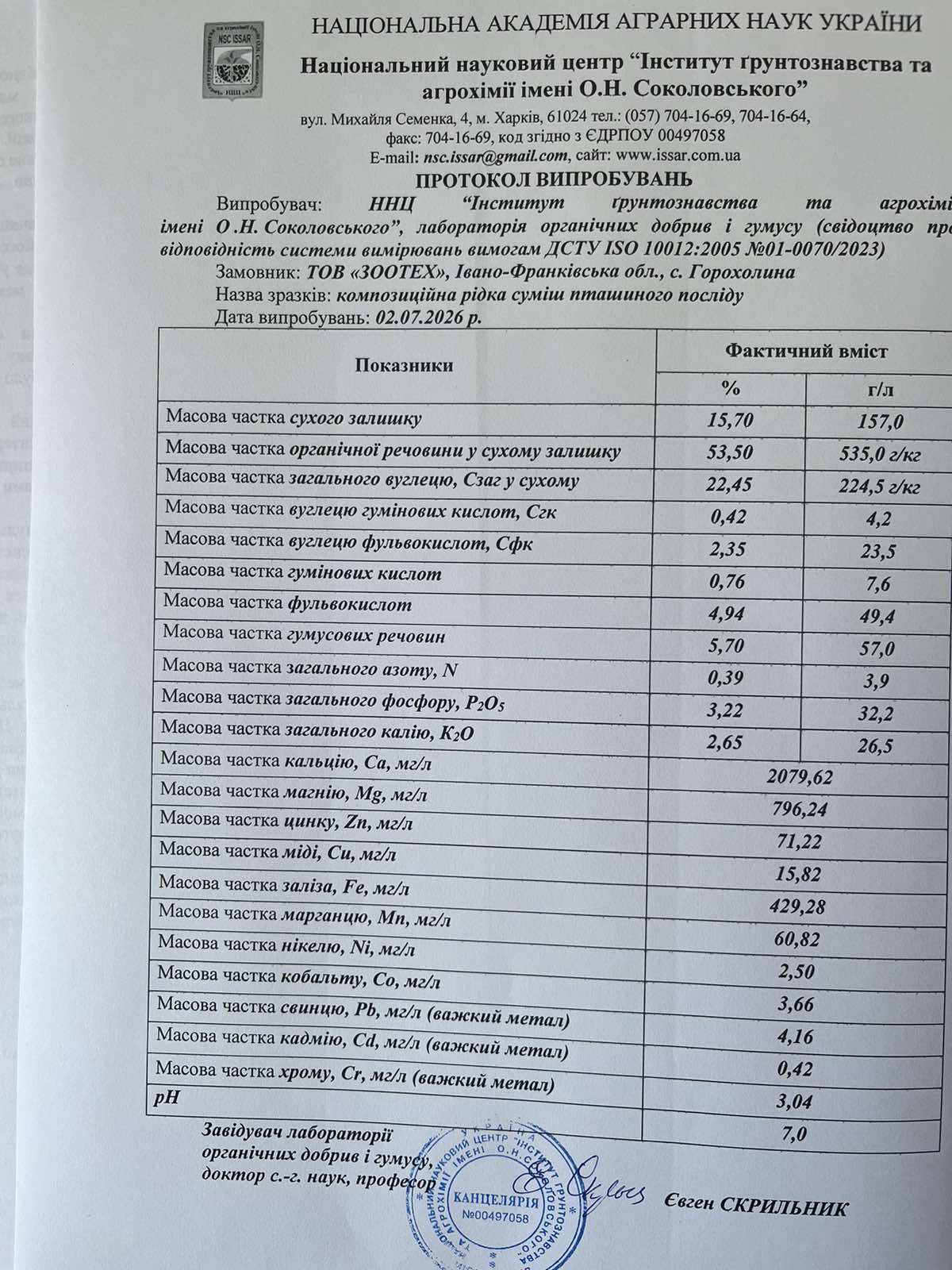
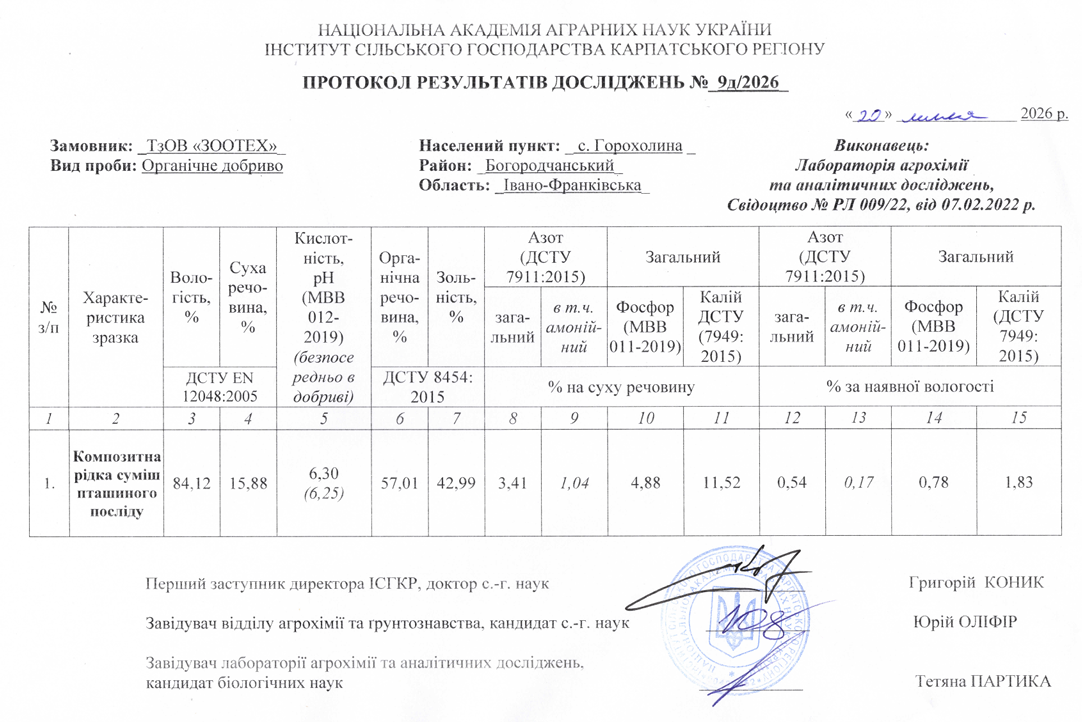
Laboratory studies show a near-neutral reaction: pH ranges from 6.3–7.0, favourable for soil application to most agricultural crops. The dry matter mass fraction is about 16 %, and organic matter accounts for 53.5–57.0 % of the dry residue. Accordingly, ash content is approximately 43.0–46.5 % of dry matter, indicating a substantial mineral component. The fertilizer is suitable for cereals, grain legumes, industrial, forage, vegetable, fruit and berry crops. It can be especially useful for crops with increased phosphorus and potassium requirements and on soils with low or medium availability of these elements. For each batch of liquid or loose solid fertilizer made to order, the pH of the solution or mixture is adjusted. Components used to adjust pH can also provide additional nutrients. This dual action allows the fertilizer composition to be selected for different stages of plant development – vegetative growth, flowering and fruiting.
Comprehensive physicochemical and agrochemical analyses of mineral and peat soils are carried out beforehand, together with determination of their physical properties: moisture, particle size distribution, acidity, nitrogen, phosphorus, potassium, calcium, magnesium, aluminium, sulphur and other required parameters. The main organic fertilizer quality parameters are determined separately: moisture, ash content, acidity, nitrogen, phosphorus and potassium. The results are used to develop complex organomineral fertilizer formulations for the agricultural enterprise’s soils and crops.
P.S. Chelated organomineral fertilizers are effective solutions for agricultural production, combining natural components, modern biotechnology and environmentally clean production approaches. They ensure stable growth and high yields, prevent nutrient leaching, help restore soil structure and develop soil microflora, which is important for maintaining soil fertility and sustainable agricultural development.
Founder of fertilizer production in Ukraine
Kononenko Serhii Viktorovych
+38 093 052 4775
Company management head office
+420 720 604 121
Recommendations
for integrated application
of organic poultry-manure-based fertilizer
Organic poultry-manure-based fertilizer is a liquid product obtained by processing organic raw materials. It contains organic matter, nitrogen, phosphorus, potassium, humic and fulvic acids, calcium, magnesium and micronutrients. It is recommended for supplementary soil feeding of agricultural crops.
According to the technical specifications, total nitrogen at the product’s actual moisture content is 0.39–0.54 %, phosphorus expressed as P2O5 is 1.5–3.5 %, and potassium expressed as K2O is 2.10–2.65 %. Dry matter content is 15.0–16.0 %, of which 53.3–58.0 % is organic matter.
The product can be included in a fertilization programme as an additional source of nutrients and organic matter. The quantities of nitrogen, phosphorus and potassium supplied to the soil depend on the application rate. At low rates, the contribution to crop macronutrient supply will be limited. Other fertilizer requirements must therefore be determined separately, taking soil analysis, crop needs and planned yield into account.
The fertilizer acts by delivering nutrients to the root development zone. Some nitrogen is in ammonium form, while organically bound nutrients gradually become plant-available through soil microorganism activity. The speed of these processes depends on temperature, moisture and soil properties.
The organic component can support biological processes in the soil. Humic and fulvic acids can interact with certain nutrients and affect their availability.
The practical effect depends on the product composition and application rate, growing conditions and the overall fertilization programme. The fertilizer is intended for cereals, grain legumes, industrial, forage, vegetable, fruit and berry crops. It can be applied during primary or pre-sowing tillage. Inter-row application is possible during the growing season.
For wheat, barley, oats, maize, sunflower and rapeseed, the product can be used during soil preparation, accounting for its contribution to the overall nutrient balance. For soybeans, peas and beans, suitability is determined primarily by soil phosphorus and potassium availability.
For vegetable and forage crops, application during tillage or inter-row feeding is possible. In fruit and berry plantations, the fertilizer is applied to the soil, preventing concentrate from reaching above-ground plant parts.
The application rate is determined from agrochemical soil analysis, considering crop needs and the actual composition of the fertilizer batch. On soils with high phosphorus availability, the rate is limited. Nitrogen nutrition is planned separately, accounting for nitrogen supplied by the product.
Before use, mix the fertilizer thoroughly until homogeneous. Use equipment suitable for liquid organic fertilizers. After surface spreading, incorporate the product into the soil as quickly as possible to reduce nitrogen losses, odour and surface runoff risk.
Avoid direct contact of the concentrate with seeds, young roots and above-ground plant parts. Do not apply to frozen, flooded or waterlogged soil, immediately before heavy rainfall, or on areas with a high risk of surface runoff.
Consultations on agrochemistry and fertilizer application
Tetiana Volodymyrivna Partyka
Mon–Fri, 1400–1700
+38 067 336 9265